Quick Answer: What is an FFR Test?
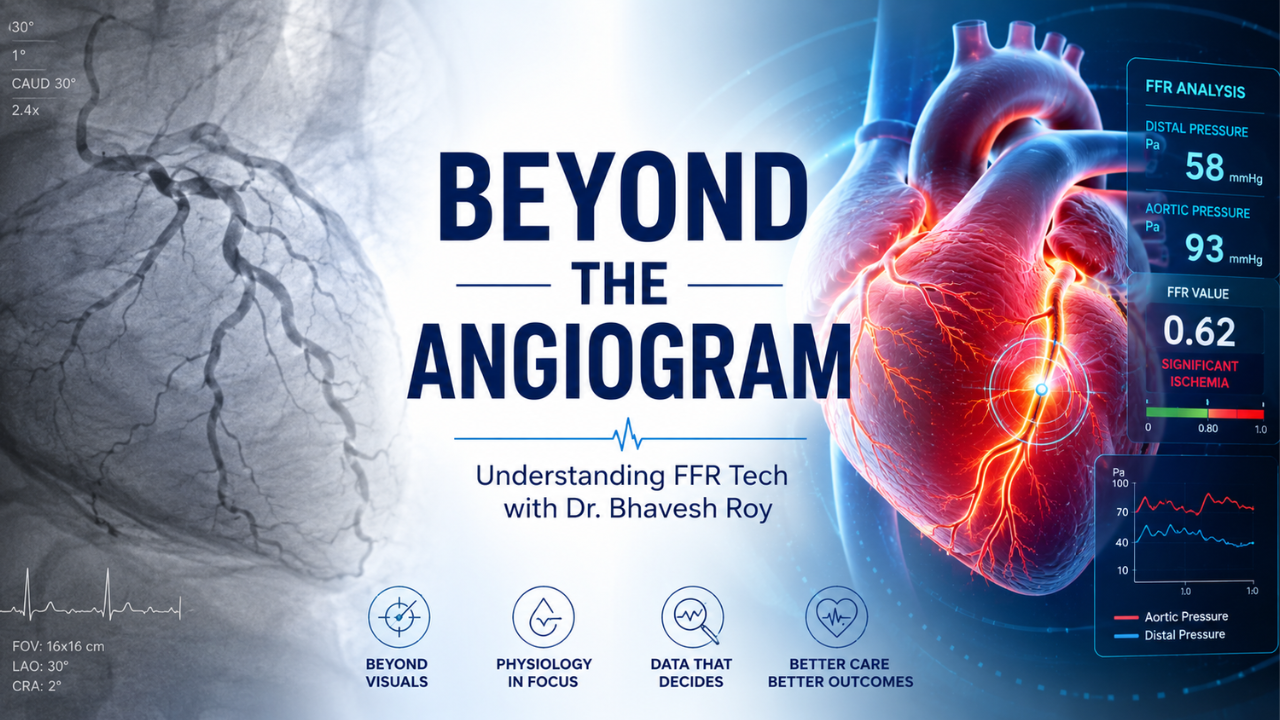
A Fractional Flow Reserve (FFR) test is a advanced diagnostic procedure performed during a coronary angiogram to measure the exact blood pressure and flow before and after a specific blockage. While a standard angiogram only shows the visual size of a plaque, FFR acts as a digital traffic sensor, determining whether a narrowing actually starves the heart of oxygen or can be safely treated with medication alone, avoiding unnecessary stenting.
Introduction
For decades, when a patient presented with chest pain or suspected coronary artery disease, the gold standard approach was a visual one. We would perform a coronary angiogram, look at the screen, and see a narrowing in the artery. If an artery looked 60% or 70% blocked, the immediate reflex was often to perform an angioplasty and place a stent.
However, modern cardiology has taught us that what the eye sees can sometimes be misleading. A blockage that looks severe on an X-ray screen might actually allow plenty of blood to pass through perfectly fine. Conversely, a seemingly moderate plaque could be choking off critical blood flow to the heart muscle.
At my practice at Zydus Hospital, Ahmedabad, we prioritize precision. We don’t just treat blockages based on appearances; we treat them based on functionality. That is where Fractional Flow Reserve (FFR) comes into play. This remarkable technology allows us to look beyond the static image and measure the exact physiological impact of a blockage in real time. In this article, we will dive into how FFR works, why it is a game-changer for complex angioplasty planning, and how it protects patients from both under-treatment and unnecessary procedures.
Table of Contents
- What is Fractional Flow Reserve (FFR)?
- The Science: How an FFR Test is Performed
- Visual vs. Functional: Coronary Angiogram vs. FFR
- Decoding the Data: What Do FFR Scores Mean?
- Why FFR is Essential for Complex Angioplasty Planning
- The Major Benefits of FFR Technology
- Who is an Ideal Candidate for an FFR Assessment?
- Frequently Asked Questions (FAQs)
- Key Takeaways
- Conclusion
What is Fractional Flow Reserve (FFR)?
Fractional Flow Reserve (FFR) is a minimally invasive diagnostic tool used to determine the functional significance of a narrowing or stenosis in your coronary arteries. The coronary arteries are responsible for supplying your heart muscle with oxygen-rich blood. When plaque builds up due to atherosclerosis, these passages narrow.
Instead of guessing how much that narrowing impacts your health, FFR provides a precise mathematical ratio. It compares the maximum possible blood flow in a blocked artery against what the blood flow would be if the artery were completely healthy and wide open. It essentially answers the critical clinical question: Is this specific plaque actually starving the heart muscle of oxygen?
The Science: How an FFR Test is Performed
An FFR assessment is conveniently performed in the Cardiac Catheterization Lab (Cath Lab) during a standard coronary angiogram or as part of a scheduled cardiac evaluation.
- Catheter Insertion: A thin, flexible tube (catheter) is inserted through an artery in your wrist or groin and carefully guided up to the opening of your coronary arteries.
- The Smart Guide-Wire: A specialized, microscopic guide-wire equipped with a highly sensitive pressure sensor at its tip is threaded through the catheter and passed across the site of the blockage.
- Simulating Stress: A specialized medication (usually adenosine) is administered intravenously. This safely mimics the effects of intense exercise by causing the microvessels in your heart to dilate completely, maximizing blood flow.
- Pressure Measurement: The sensor measures the blood pressure downstream from the blockage while a separate sensor measures the pressure upstream. The computer instantly calculates the ratio between the two numbers to generate your FFR score.
Visual vs. Functional: Coronary Angiogram vs. FFR
To understand why this tech is so powerful, look at how a traditional angiogram stacks up against an FFR assessment:
| Feature | Traditional Coronary Angiogram | Fractional Flow Reserve (FFR) |
|---|---|---|
| Core Insight | Provides a 2D anatomical map showing the structural size of a blockage. | Provides a physiological metric showing the functional impact on blood flow. |
| Method | Visual inspection via contrast dye and X-ray imaging (Fluoroscopy). | Sensor-tipped wire measurements of active blood pressure differences. |
| Clinical Risk | Can lead to over-stenting borderline blockages that aren’t causing harm. | Prevents unnecessary stenting by proving which lesions are harmless. |
| Primary Benefit | Excellent for finding obvious structural blockages and emergency clots. | The definitive tool for resolving grey-area or complex, multi-vessel blockages. |
Decoding the Data: What Do FFR Scores Mean?
The beauty of FFR lies in its clarity. The maximum flow in a perfectly normal, unobstructed coronary artery is represented by a score of 1.0.
FFR Score > 0.80  ------> Ischemia NEGATIVE ------> Treat with Medication (No Stent Needed)
FFR Score ≤ 0.80  ------> Ischemia POSITIVE ------> Treat with Angioplasty / Stenting
- An FFR Score greater than 0.80 means that despite the visual plaque, more than 80% of normal blood flow is successfully squeezing past the narrowing. The blockage is not causing significant oxygen deprivation (ischemia). Studies confirm these patients have excellent outcomes when managed with optimal medical therapy alone.
- An FFR Score of 0.80 or less indicates a critical, flow-restricting blockage. It means blood flow to that part of the heart has dropped by 20% or more. This confirms that the narrowing is dangerous, likely responsible for symptoms like angina, and requires mechanical revascularization through complex angioplasty or stenting.
Why FFR is Essential for Complex Angioplasty Planning
When dealing with complex coronary artery disease—such as patients with multiple blockages (multi-vessel disease), bifurcation lesions (where an artery splits), or calcified vessels—FFR shifts from an optional tool to an essential guide.
In patients with multiple narrowings, it is incredibly common for an angiogram to show three or four “scary-looking” blockages. Historically, this might automatically disqualify a patient from angioplasty and push them toward open-heart bypass surgery (CABG). However, by utilizing FFR, we frequently discover that only one or two of those blockages are actually restricting flow. By pinpointing the true culprit lesions, we can perform a highly targeted, multi-vessel complex angioplasty, treating only what is broken and leaving the rest alone safely.
The Major Benefits of FFR Technology
- Eliminates Guesswork: Replaces subjective visual assessments with hard, objective physiological data.
- Reduces Unnecessary Procedures: Up to one-third of visual blockages evaluated by FFR are found to be functionally harmless, saving patients from getting unnecessary hardware implants.
- Improves Patient Outcomes: Large clinical trials (like the FAME trials) prove that FFR-guided therapy significantly reduces the risk of long-term heart attacks and cardiac events compared to standard angiogram-guided stenting.
- Cost-Effective and Safer: Fewer stents mean lower procedural risks, shorter recovery times, and reduced overall healthcare costs for families.
Who is an Ideal Candidate for an FFR Assessment?
While FFR is an incredible asset, it isn’t required for every single patient. For example, if a patient is actively suffering a massive heart attack, the culprit artery is completely closed off (100% occlusion) and needs immediate opening without secondary testing.
Instead, FFR is ideally suited for:
- Patients with stable angina or chronic chest pain whose non-invasive stress tests were ambiguous.
- Individuals found to have “borderline” or intermediate narrowings (ranging between 50% to 70% diameter stenosis).
- Patients diagnosed with multi-vessel disease to map out which specific lesions require stenting versus those that can bypass surgery.
Frequently Asked Questions (FAQs)
1. Is the FFR test painful?
No, the FFR test itself does not cause pain. It is performed through the same catheter used for your angiogram. When the medication (adenosine) is injected to maximize blood flow, you might feel a mild, brief flushing sensation or warmth in your chest lasting less than a minute, which quickly dissipates.
2. Does a high FFR score mean my artery is perfectly clean?
Not necessarily. A score above 0.80 simply means that whatever plaque is present is not currently restricting blood flow to a dangerous level. You will still need life-long lifestyle modifications and medications like statins to stabilize that plaque and prevent it from growing or rupturing.
3. How long does an FFR procedure add to an angiogram?
Because the setup is integrated into our high-tech Cath Lab equipment at Zydus Hospital, conducting an FFR evaluation usually adds only an extra 10 to 15 minutes to a standard diagnostic angiogram procedure.
4. Are there risks associated with an FFR test?
Because it is performed during a routine cardiac catheterization, it shares the same minor risks as a standard angiogram (such as minimal bruising at the wrist or groin access site). The specialized guide-wire used is incredibly safe and designed to glide smoothly through your vessels without damaging the inner lining.
Key Takeaways
- Visual blockages on an angiogram can be highly deceptive; structural narrowing does not always equal blocked blood flow.
- FFR is a smart, sensor-tipped wire technology that calculates the functional severity of heart blockages using live pressure ratios.
- An FFR score of ≤ 0.80 demands mechanical treatment (angioplasty), while a score > 0.80 means stenting can be safely avoided in favor of medications.
- FFR guidelines drastically reduce the rate of over-stenting and improve long-term patient safety profiles in complex coronary disease.
Conclusion
Your heart is far too precise an organ to rely on visual guesswork alone. By adopting data-driven, advanced coronary diagnostic technologies like Fractional Flow Reserve (FFR), we ensure that every stent placed inside a patient’s coronary artery is absolutely necessary and life-improving. If you or a loved one are navigating choices regarding complex heart blockages, multi-vessel disease, or borderline angiogram results, remember that a functional assessment could completely rewrite your care plan for the better.
Consult Dr. Bhavesh Roy for Cardiovascular Evaluation
Have you been told you have intermediate or complex heart blockages after a routine health check-up or angiogram? Don’t leave your treatment up to a visual estimate. Contact Dr. Bhavesh Roy today at Zydus Hospital, Ahmedabad, to discuss your options for a precise, FFR-guided cardiovascular evaluation. Ensure your heart receives exactly the care it needs—no more, no less. Schedule your consultation online via drbhavesh.com.
Medical Disclaimer: The educational information provided in this article should not replace professional medical consultations, formal diagnosis, or direct treatment advice. If you are experiencing acute chest pain, radiating discomfort, or acute shortness of breath, please dial your local emergency services immediately. Always review specialized cardiac procedures with a certified interventional cardiologist like Dr. Bhavesh Roy.