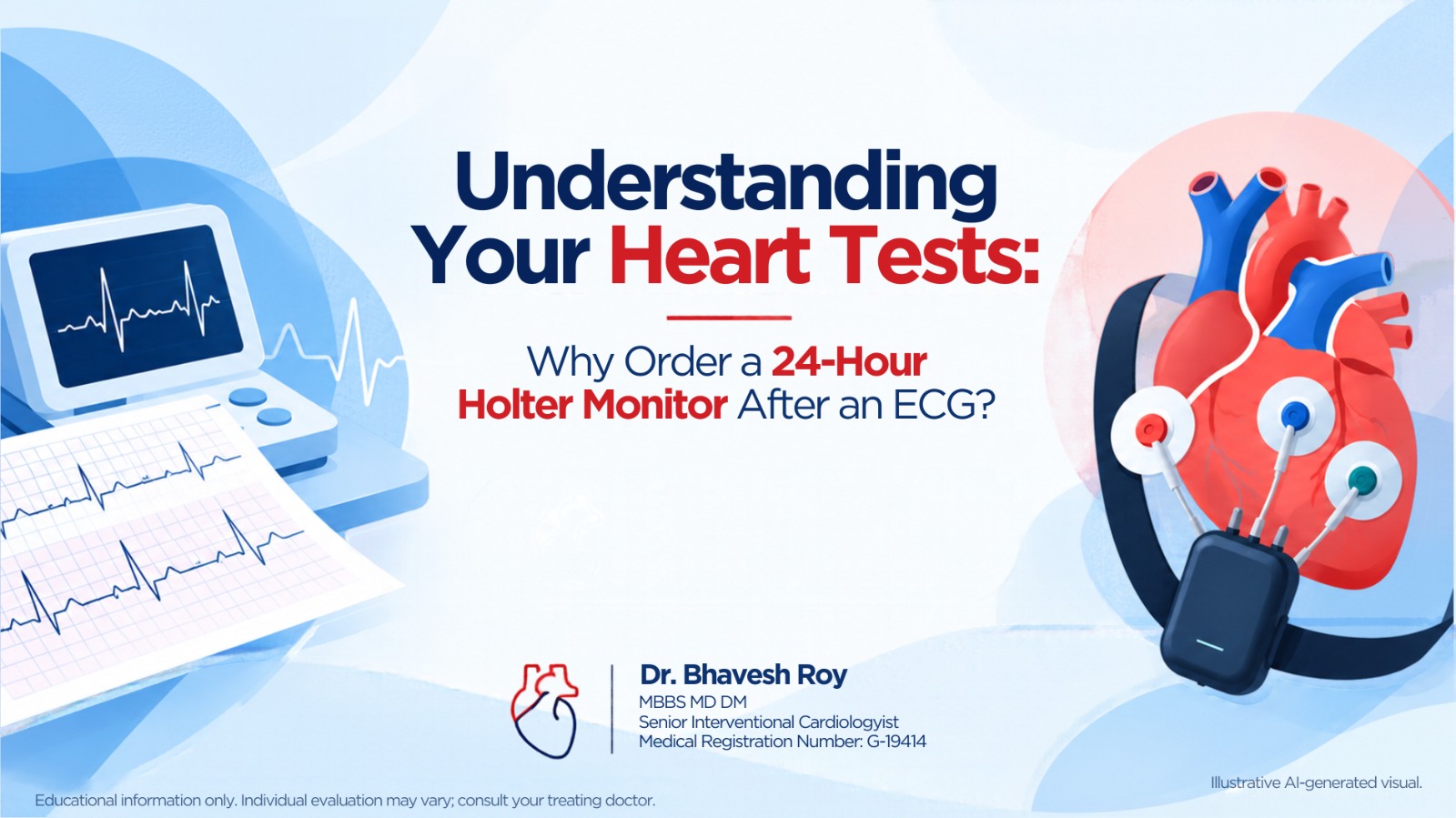
Quick Answer: Why Both Tests?
Many patients ask why their cardiologist ordered a 24-Hour Holter Monitor after already performing a standard Electrocardiogram (ECG) in the clinic. Basically, these two diagnostic tools capture completely different time frames of your heart’s electrical activity. A standard clinic ECG records a brief, 10-second snapshot of your heart rhythm while you lie completely still. Conversely, a Holter monitor tracks your heart’s continuous electrical signals for 24 to 48 hours during your normal daily routine. Therefore, combining both evaluations allows your doctor to detect intermittent rhythm disturbances that rarely show up during a short clinic visit. Ultimately, this factual data helps doctors identify hidden electrical issues accurately.
Introduction: Gathering Complete Medical Data
Cardiologists frequently evaluate intermittent palpitations, unexplained dizziness, fluttering sensations, or brief fainting spells (syncope) in their clinics. Consequently, they always begin with a standard resting ECG. However, you might also receive a recommendation for a 24-hour Holter monitoring test—even if your initial clinic ECG looked completely normal. Naturally, you might wonder why a single clinic test cannot provide all the necessary answers.
Your heart’s electrical system fires over 1,00,000 times every single day. It adjusts constantly to physical exertion, emotional stress, and sleep. A brief recording in a quiet examination room rarely captures fleeting rhythm changes. Accordingly, medical professionals use extended monitoring to gather distinct, factual information. This article explains the scientific rationale behind ordering a Holter monitor alongside a standard ECG.
Table of Contents
- What is a Standard Electrocardiogram (ECG)?
- What is a 24-Hour Holter Monitor?
- The Crucial Question: Why Order a Holter After a Normal ECG?
- Understanding Your Factual Clinical Assessment
- Frequently Asked Questions
What is a Standard Electrocardiogram (ECG)?
A standard Electrocardiogram functions as a rapid, baseline recording of your heart’s electrical system. During this painless test, a technician attaches small adhesive sensors (electrodes) to your chest, arms, and legs while you rest on an examination table. This test involves zero ionizing radiation or electrical shocks.
Specifically, this 10-second test allows doctors to see your immediate heart rate, baseline electrical rhythm, and signs of prior or ongoing structural strain. Doctors mainly use this test to check for persistent electrical abnormalities present at the exact moment of the recording. However, a resting ECG cannot show what happens to your heart rhythm after you leave the clinic and resume your daily activities.
What is a 24-Hour Holter Monitor?
Medical professionals describe a Holter monitor as a portable, wearable ambulatory ECG device. During this test, a technician places a few small adhesive electrodes on your chest and connects them to a lightweight digital recorder worn on a belt, strap, or pocket.
Throughout the next 24 to 48 hours, you go home and perform your regular daily routine—walking, working, eating, and sleeping—while the device records every single heartbeat continuously. Additionally, you maintain a simple symptom diary to note the exact time you feel any palpitations, dizziness, or chest discomfort. Consequently, the doctor can directly compare your physical symptoms with the exact electrical activity occurring in your heart at that exact minute.
The Crucial Question: Why Order a Holter After a Normal ECG?
Understanding the unique recording window of each diagnostic tool answers the main question. They simply do not evaluate the same duration or physiological conditions.
First, consider a helpful photography analogy. A standard clinic ECG acts like taking a single still photograph of a busy highway. That single photo clearly shows the cars present at that exact second, but it misses everything that happens five minutes later. Second, a 24-hour Holter monitor acts like a continuous 24-hour CCTV video recording of that exact same highway. The continuous recording captures every sudden traffic jam or unusual event, whether it happens at midday or 3:00 AM.
Therefore, cardiologists frequently need both distinct perspectives. Many cardiac arrhythmias—such as intermittent atrial fibrillation, premature beats, or brief pauses in heart rhythm—occur unpredictably and vanish within minutes. A patient might have a perfectly normal 10-second clinic ECG, yet experience significant rhythm fluctuations while climbing stairs at home or sleeping at night. Ultimately, utilizing extended monitoring ensures a thorough, factual clinical assessment.
Understanding Your Factual Clinical Assessment
Medical guidelines encourage thorough, evidence-based evaluations for unexplained cardiac symptoms. Relying solely on a 10-second test might leave intermittent electrical questions completely unanswered. When doctors combine a baseline clinic ECG with continuous ambulatory data, they map out your true cardiac rhythm safely.
You should never hesitate to ask your physician regarding your specific monitoring results. Understanding your heart’s electrical patterns empowers you. Accurate medical information helps you make sensible, informed healthcare decisions moving forward.
Frequently Asked Questions
- 1. Does a Holter monitor expose me to radiation or electrical shocks?
- No. Like a standard ECG, a Holter monitor only passively records your body’s natural surface electrical signals. The device does not emit radiation, heat, or electricity into your body.
- 2. Can I bathe or shower while wearing a Holter monitor?
- Standard Holter monitors and their chest electrodes must remain completely dry to ensure an uninterrupted recording. Clinics generally advise taking a bath or shower right before your appointment to have the device fitted. Always follow your specific clinic guidelines.
- 3. What should I do if I feel palpitations while wearing the device?
- Note the exact time and what activity you were doing in your patient diary. Many monitors also feature a dedicated “event button” that you can press to bookmark that exact moment for the cardiologist reviewing your report.
Diagnostic Services Information
This educational material provides factual, objective information regarding cardiovascular testing. In accordance with ethical advertising guidelines, clinical establishments may communicate verifiable particulars concerning their facilities and available doctors without patient solicitation or inducement.
Dr. Bhavesh Roy
MBBS, MD (Internal Medicine), DM (Cardiology)
Senior Interventional Cardiologist
Gujarat Medical Council Reg. No.: G-19414
Current Affiliation: Zydus Hospital, Ahmedabad
In compliance with National Medical Commission guidelines, clinical establishments and Registered Medical Practitioners publishing electronic media posts must transparently disclose the practitioner’s name, qualifications, registration status, and State Medical Register (SMR) or National Medical Register (NMR) number. This educational material serves public awareness. It does not promote personal practice, solicit patients, or make unverifiable medical claims.
By Dr. Bhavesh Roy
Qualifications: MBBS, MD (Internal Medicine), DM (Cardiology)
Registration Status: Senior Interventional Cardiologist
SMR Registration Number: G-19414 (Gujarat Medical Council)
Medical Disclaimer
This article provides general educational information and is not a substitute for individual medical advice, clinical diagnosis, or prescribed treatment. Palpitations, dizziness, and heart rhythm changes can have different causes, and assessment should take individual symptoms and medical history into account. Do not change or stop prescribed medication based on this article. If you experience sudden fainting, severe chest pain, extreme shortness of breath, or a sustained racing heartbeat accompanied by dizziness, seek emergency medical care immediately.