Quick Answer: Why Both Tests?
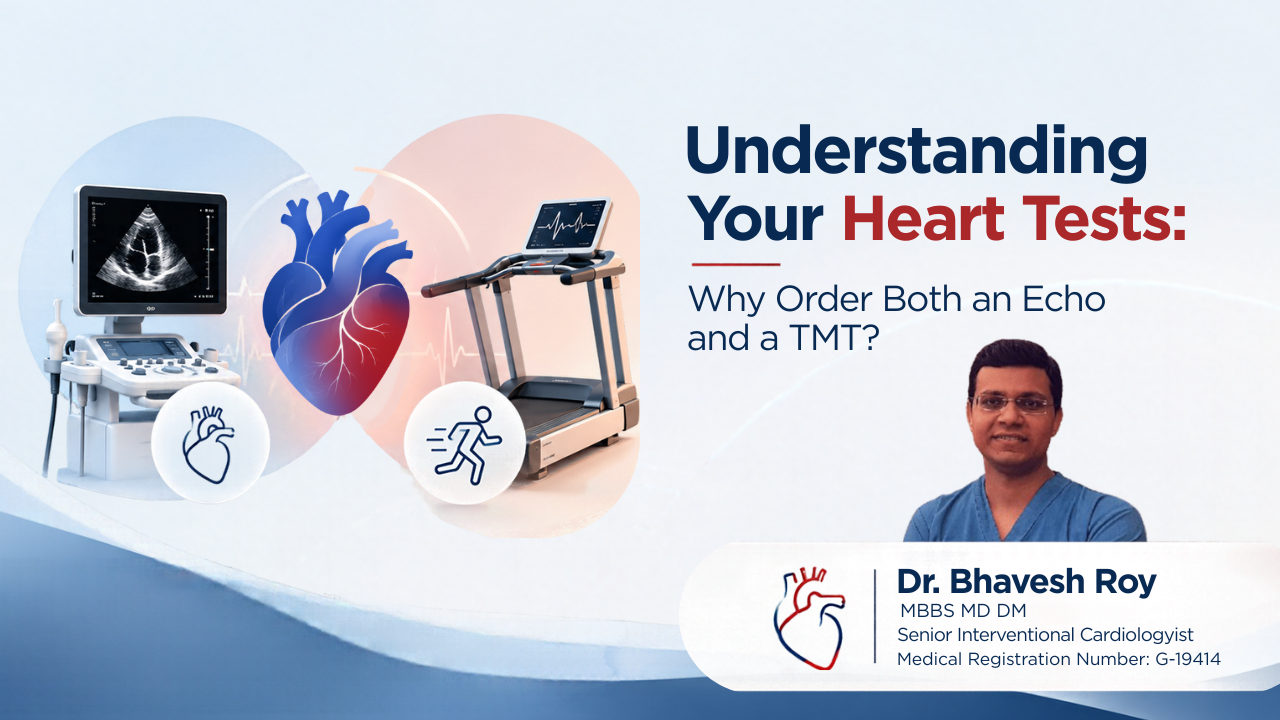
Many patients ask why their cardiologist ordered both an Echocardiogram (Echo) and a Treadmill Test (TMT). Basically, these two tests evaluate completely different aspects of your heart. An Echo provides a structural picture, showing how your heart muscles and valves look while resting. Conversely, a TMT assesses functional performance, revealing how your heart behaves under physical stress. Therefore, combining both tests gives your doctor a comprehensive cardiovascular evaluation. Ultimately, this factual data helps doctors identify hidden issues accurately.
Introduction: Gathering Complete Medical Data
Cardiologists frequently evaluate chest pain, breathlessness, or irregular heartbeats in their clinics. Consequently, they often prescribe specific diagnostic tests. You might receive a prescription for an Echocardiogram alongside a Treadmill Test. Naturally, you might wonder why a single test cannot provide all the necessary answers.
Your heart operates as a highly complex mechanical and electrical system. One imaging method rarely captures the entire clinical picture. Accordingly, medical professionals use multiple tests to gather distinct, factual information. This article explains the scientific rationale behind ordering both an Echo and a TMT.
Table of Contents
- What is an Echocardiogram (Echo)?
- What is a Treadmill Test (TMT)?
- The Crucial Question: Why Order Both?
- Understanding Your Factual Clinical Assessment
- Frequently Asked Questions
What is an Echocardiogram (Echo)?
An Echocardiogram functions as a specialized ultrasound for your heart. The technician uses safe sound waves to create real-time, moving images of your cardiac structures. This test involves zero ionizing radiation.
Specifically, this imaging method allows doctors to see the physical size of your heart chambers. Furthermore, it reveals exactly how well your heart valves open and close. Doctors mainly use this test to check your pumping capacity at a resting state. However, a resting Echo cannot show what happens when your heart works hard.
What is a Treadmill Test (TMT)?
Medical professionals also call the Treadmill Test an exercise stress test. During a TMT, you walk on a clinical treadmill while connected to an ECG monitor.
Gradually, the technician increases the treadmill’s speed and incline. This physical exertion forces your heart to pump faster and demand more oxygen. Consequently, the test reveals hidden electrical abnormalities or blood flow restrictions. If your coronary arteries possess significant blockages, the ECG will clearly show these specific electrical changes during intense exercise.
The Crucial Question: Why Order Both?
Understanding the unique purpose of each diagnostic tool answers the main question. They simply do not measure the same physiological functions.
First, consider a helpful mechanical analogy. An Echo acts like a mechanic looking under the hood while a car sits parked. The mechanic sees the physical engine parts clearly. Second, the TMT acts like taking that exact same car for a high-speed test drive. The test drive reveals exactly how the engine performs under actual physical stress.
Therefore, cardiologists need both distinct perspectives. A patient might have a perfectly normal resting Echo, yet fail a TMT due to severe artery blockages. Conversely, a patient might easily pass a TMT but show a faulty, leaking heart valve on an Echo. Ultimately, utilizing both tests ensures a thorough, factual clinical assessment.
Understanding Your Factual Clinical Assessment
Medical guidelines encourage thorough, evidence-based evaluations. Relying on just one test might leave critical medical questions completely unanswered. When doctors combine structural data with functional data, they map out your true cardiovascular health safely.
You should never hesitate to ask your physician regarding your specific test results. Understanding your numbers empowers you. Accurate medical information helps you make sensible, healthy lifestyle decisions moving forward.
Frequently Asked Questions
- 1. Do these tests expose me to radiation?
- No. An Echocardiogram utilizes sound waves, while a Treadmill Test records surface electrical activity. Neither test involves dangerous ionizing radiation.
- 2. Which test usually happens first?
- Doctors frequently perform the Echo first to ensure your heart possesses the structural stability required to safely endure the physical stress of a TMT.
- 3. Can I eat before a TMT?
- Medical clinics generally advise fasting for a few hours before a stress test. Exercising vigorously on a full stomach often causes severe nausea. Always follow your specific clinic guidelines.
Diagnostic Services Information
This educational material provides factual, objective information regarding cardiovascular testing. In accordance with ethical advertising guidelines, clinical establishments may communicate verifiable particulars concerning their facilities and available doctors without patient solicitation or inducement.
Dr. Bhavesh Roy
MBBS, MD (Internal Medicine), DM (Cardiology)
Senior Interventional Cardiologist
Gujarat Medical Council Reg. No.: G-19414
Current Affiliation: Zydus Hospital, Ahmedabad
In compliance with National Medical Commission guidelines, clinical establishments and Registered Medical Practitioners publishing electronic media posts must transparently disclose the practitioner’s name, qualifications, registration status, and State Medical Register (SMR) or National Medical Register (NMR) number. This educational material serves public awareness. It does not promote personal practice, solicit patients, or make unverifiable medical claims.
By Dr. Bhavesh Roy
Qualifications: MBBS, MD (Internal Medicine), DM (Cardiology)
Registration Status: Senior Interventional Cardiologist
SMR Registration Number: G-19414 (Gujarat Medical Council)
Medical Disclaimer
This article provides general educational information and is not a substitute for individual medical advice, clinical diagnosis or prescribed treatment. Headaches and blood pressure changes can have different causes, and assessment should take individual symptoms and medical history into account. Do not change or stop prescribed medication based on this article. If you have a blood pressure reading above 180/120 mmHg with concerning symptoms, seek emergency medical care. A sudden, extremely severe headache or new neurological symptoms also require emergency assessment.